
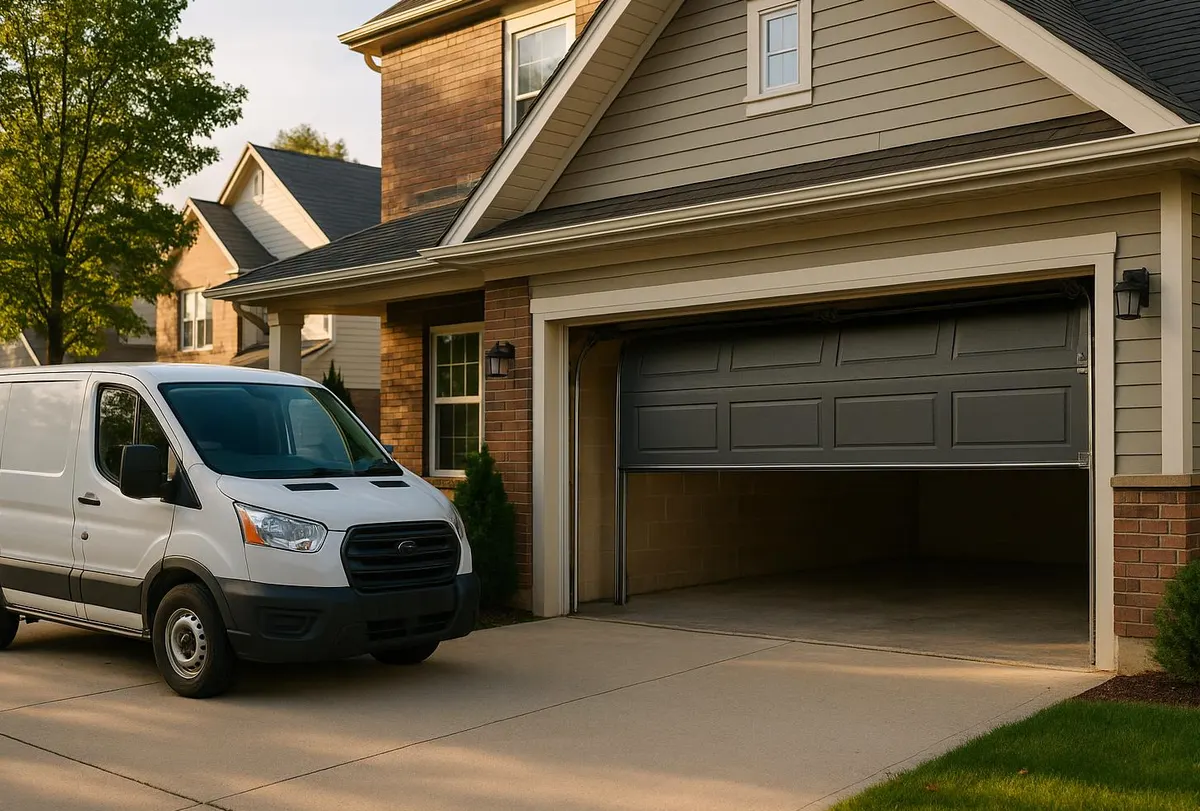
What a Technician Sees on This Call
This comes up more than you'd think: one spouse wants to upgrade to an insulated garage door because the garage feels like a meat locker every January, and the other thinks it's a waste of money since "it's just a garage." By the time we get the call, there's usually a stack of printouts from different websites and nobody agreeing on what R-value even means. So let's settle it with what actually matters, not marketing copy.
What R-Value Actually Measures
R-value measures how well a material resists heat transfer. Higher number, better insulation. A single-layer steel garage door has almost no R-value — it's basically a sheet of metal with air on both sides. An insulated door sandwiches foam (usually polystyrene or polyurethane) between two steel layers, which is where the R-value rating comes from, often somewhere in the 6 to 18 range depending on thickness and foam type.
Here's the part that gets glossed over: R-value is a lab number measured on the panel itself, not the whole assembly. Gaps around the perimeter, a worn bottom seal, and thin weatherstripping around the frame can leak more air than the panel insulation ever saves. A high R-value door with bad seals performs worse than a lower R-value door that's sealed tight.
Who Genuinely Benefits
- Attached garages where the garage shares a wall with the house. Heat and cold move through that shared wall and door more than people expect, especially if there's a bedroom, laundry room, or living space above or beside it.
- Garages with a finished or semi-finished room above them. That space gets hammered by whatever temperature swing the garage experiences underneath it. An insulated door reduces how hard that upstairs room has to work to stay comfortable.
- Anyone who uses the garage as a workshop, home gym, or hangout space. If you're spending real time out there in January or July, insulation changes how livable it is, full stop.
- Homes with a heated or conditioned garage. If you're running ductwork, a mini-split, or even just a space heater out there regularly, an uninsulated door is burning that money straight through the panel.
Why This Matters More Here
Cincinnati winters bring real cold, ice, and road salt tracked in on car tires, plus humid, sticky summers. That's a big seasonal swing, and an attached garage without insulation acts like a thermal bridge between outside conditions and your house. In winter that cold garage pulls heat from the shared wall; in summer the humidity and heat soak through the same way. Homes here feel that swing more than homes in milder climates.
Who's Paying for Nothing
- Detached garages with no conditioning and no living space nearby. If nobody's heating or cooling it and it's not attached to the house, the insulated door is mostly just a nicer-looking, quieter, more dent-resistant door — which isn't nothing, but it's not saving you energy money either.
- Garages used strictly for parking, opened twice a day, with no adjacent living space. The temperature swing inside doesn't have much to transfer to.
- Anyone buying based on R-value number alone without checking door thickness, seal quality, and whether their garage situation even calls for it. A high R-value tag on the box doesn't mean much if the installation around it is sloppy.
The Real Trade-Offs
Insulated doors cost more upfront, with national price ranges typically running higher than a comparable non-insulated steel door of the same size and style — expect it to be a real difference, not a rounding error. They're also heavier, which means the opener, springs, and track all need to be sized correctly for that added weight. This is one of the more common mistakes we see: someone upgrades the door but keeps the old springs or opener, and within a few months the system is straining, the opener burns out early, or the door doesn't seat evenly.
On the upside, insulated doors tend to be quieter (less rattle and vibration), more dent-resistant because of the layered construction, and they hold up better against the freeze-thaw stress that cold winters and salt exposure put on a door over years.
A Quick Way to Decide
- Is the garage attached to the house, or is there living space above/beside it? If yes, insulation earns its keep.
- Do you spend real time out there, or run heat/AC to it? If yes, same answer.
- Is the garage detached and used only for parking? Insulation is a nice-to-have, not a money-saver.
- Before buying anything, check the current door's seals and weatherstripping — sometimes the fix is cheaper than a new door entirely.
When to Call Cincinnati Garage Door Pro
If you're trying to figure out whether your specific setup — attached garage, finished room above, workshop, whatever it is — actually justifies an insulated upgrade, that's worth a real look rather than a guess. We can assess your current door's condition, check seals and weatherstripping, and walk through Garage Door Installation options sized correctly for an insulated panel, including whether your opener and springs need upgrading to handle the added weight. If you're not ready for a full replacement, our Garage Door Maintenance service can tighten up seals and weatherstripping first to see how much of your comfort problem that solves on its own before you spend on a new door.
Give Cincinnati Garage Door Pro a call and we'll give you a straight answer about whether insulation makes sense for your garage, not just a sales pitch. We're on Harrison Ave and serve homeowners throughout Cincinnati, Cheviot, Bridgetown, Delhi Township, Green Township, Westwood, Colerain Township, and Norwood.